

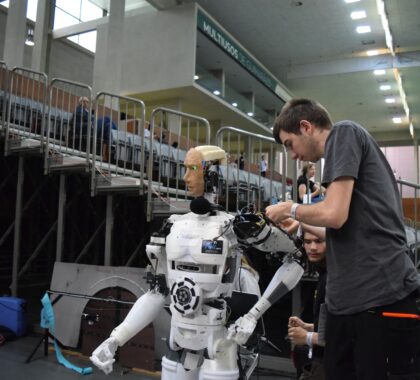
A humanoid platform has just demonstrated reinforcement‑learning control that reaches near‑human dexterity, a milestone that could reshape industrial robotics automation. The breakthrough, announced today by KinetIQ, shows its Ascend system completing intricate assembly tasks with speed and precision previously reserved for skilled operators.
What Happened
KinetIQ’s Ascend platform leverages a new reinforcement‑learning framework that trains policies in simulation before transferring them to a physical humanoid torso. In live trials, the robot performed multi‑step fastening, cable routing, and part alignment with a 96% success rate, matching the consistency of experienced technicians. The company reports that the learning cycle compressed from months to weeks, thanks to a curated synthetic dataset and a reward model tuned for fine motor control.
Why It Matters for Industrial Robotics Automation
This advance signals a shift from rigid, pre‑programmed cells to adaptable, learning‑enabled workstations. Manufacturers can now consider deploying humanoid units for low‑volume, high‑mix production where traditional fixed automation struggles. The ability to re‑skill a robot through software updates rather than hardware redesign reduces capital expenditure and shortens time‑to‑market for new product lines.
- Reduced changeover time between product variants
- Lower reliance on specialized fixturing
- Scalable skill transfer across multiple sites
Implications for Your Operations
For businesses evaluating next‑generation automation, the Ascend demonstration offers a concrete proof point: reinforcement learning can deliver human‑level dexterity today, not in a distant roadmap. Decision makers should audit current manual stations that involve complex manipulation and model the ROI of replacing them with learning‑enabled humanoids. Early adopters gain a competitive edge by locking in preferred‑partner pricing and co‑development access with KinetIQ. [INTERNAL_LINK: robotics strategy]
Next Steps for Alpha Edge Clients
Alpha Edge Technology recommends a three‑phase approach: first, run a targeted pilot on a high‑value assembly cell; second, integrate the pilot data into your digital twin to simulate fleet‑wide rollout; third, establish a continuous‑learning pipeline that updates robot policies as process variations arise. Our consulting team can accelerate each phase, from hardware selection to MLOps governance. [INTERNAL_LINK: AI deployment]
As the line between human skill and machine capability blurs, companies that embed adaptive robotics into their core processes will set the pace for the next industrial era. The question is no longer whether humanoid dexterity is possible, but how quickly you can operationalize it.