

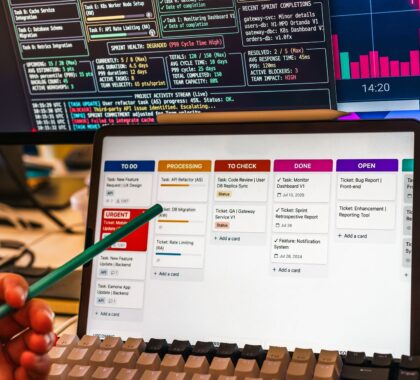
Why chasing subcontractors feels like a never‑ending task
You spend hours each week calling, texting, and emailing subcontractors.
You ask for availability, confirm start times, and follow up on changes.
Many of those messages go unanswered.
You repeat the same chase because you have no reliable record of what was said.
The effort feels like work that never finishes.
What AI scheduling for contractors actually does
AI scheduling for contractors stops the chase by creating confirmation loops and escalation rules that make every missed follow‑up visible.
The system logs each request, each response, and each attempt to reach a subcontractor.
When a response is missing, the software raises an alert according to rules you set.
The record settles disputes because it shows exactly what was communicated and when.
The goal is not to replace staff but to give them a reliable tool that prevents repeat work.
Confirmation loops, escalation rules, and the dispute record
A confirmation loop works like this: you send a schedule request, the system waits for a reply, and if none arrives within a set time it sends a reminder.
You can set the reminder interval—say, two hours—and the number of repeats—say, three.
If after the third reminder there is still no reply, an escalation rule triggers.
The escalation might be a text to the subcontractor’s supervisor or a notification to your project manager.
Every step is timestamped and stored in a searchable log.
When a disagreement arises about who said what, you open the log and see the exact sequence.
The log removes guesswork and prevents the same issue from recurring.
A concrete example you can verify with your own numbers
Imagine you miss ten calls a week from subcontractors who need to confirm a job.
Each missed call leads to a delay that costs you $400 in lost billable time.
Ten missed calls × $400 = $4,000 per week.
Four weeks in a month gives $16,000 of avoidable cost.
You can replace the ten‑call number with your actual weekly missed calls.
You can replace the $400 figure with your average revenue per visit.
The arithmetic is simple: (missed calls per week) × (cost per missed call) × 4 = monthly loss.
If your numbers are lower, the loss is lower; if they are higher, the loss is higher.
The point is that the loss repeats until you have a system that catches each miss.
AI scheduling for contractors gives you that system.
How to act on this – linking to consulting or apply program
You can start by reviewing your current call log and counting missed contacts.
Then set up confirmation loops in the software with intervals that match your workflow.
Define escalation rules that go to the person who can actually get a response.
Train your team to treat the log as the source of truth for scheduling.
If you need help configuring the loops and rules, we offer AI consulting for your operation.
Visit AI consulting for your operation to schedule a review.
If you prefer to try the solution yourself, you can apply for the current program.
Visit apply for the current program to get access.
The consulting link is a money page; the apply link is also a money page.
Both pages explain pricing, implementation steps, and the support you receive.
You can check the cost against the monthly loss you calculated earlier.
If the consulting fee is less than your estimated loss, the investment pays for itself.
Looking ahead – what stays constant and what improves
Subcontractors will still need to be contacted; human judgment will still be required for complex negotiations.
What changes is the visibility of every attempt and the speed of the response.
You will spend less time chasing and more time on work that generates revenue.
The record that settles a dispute becomes a routine output, not a special project.
Over weeks, the reduction in missed contacts shows up in your bottom line.
You can measure the improvement by comparing the monthly loss before and after implementation.
The goal is steady, repeatable coverage against a loss that repeats.