

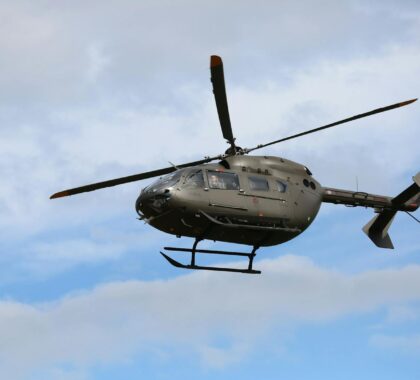
The U.S. Marine Corps is betting on proven helicopter platforms to accelerate its unmanned logistics capabilities — and the decision could reshape how military and commercial operators alike think about eVTOL aircraft technology in medium-lift resupply roles.
In a move announced this month, the Marines have selected Sikorsky and Robinson Helicopter Company to adapt the Robinson R66 — a light turbine-powered helicopter — into an autonomous unmanned aerial system for medium resupply missions. The effort aims to reduce risk to personnel, extend operational reach, and deliver critical supplies to forward-deployed units without requiring a pilot on board.
Why the R66 Platform Matters
The Robinson R66 is already one of the most widely produced light turbine helicopters in the world, with a mature supply chain and extensive flight-hour pedigree. By choosing a certified, production-ready airframe rather than a clean-sheet design, the Marine Corps is compressing development timelines significantly. Sikorsky brings decades of autonomous flight systems expertise — including work on the Matrix™ autonomy system — while Robinson contributes deep manufacturing and sustainment knowledge.
This partnership signals a broader trend: defense programs are increasingly turning to commercial aviation platforms as the foundation for unmanned systems, rather than building from scratch. The approach reduces cost, leverages existing type certifications, and shortens the path from prototype to fielding.
What This Means for the Broader Sector
The implications extend well beyond military logistics. As of 2026, the global market for autonomous cargo drones and advanced air mobility platforms is experiencing rapid convergence. Several factors are driving this:
- Regulatory momentum: Aviation authorities worldwide are finalizing frameworks for beyond-visual-line-of-sight (BVLOS) unmanned operations, opening doors for commercial cargo and infrastructure inspection use cases.
- Supply chain resilience: Companies across energy, mining, and disaster response are evaluating autonomous resupply to reduce dependence on ground transport in remote or contested environments.
- Technology maturation: Advances in sense-and-avoid systems, AI-driven mission planning, and modular payload integration are making medium-lift unmanned platforms commercially viable for the first time.
- Operational efficiency: Autonomous medium-lift drones can reduce resupply cycle times by up to 40% in remote or infrastructure-limited environments, according to current industry benchmarks.
- Risk reduction: Removing personnel from dangerous resupply corridors — whether in conflict zones, disaster areas, or harsh industrial settings — directly lowers liability and insurance exposure.
- Data integration: Modern unmanned platforms generate rich telemetry and operational data that feeds directly into AI-driven decision systems, creating compounding value over time.
[INTERNAL_LINK: autonomous logistics solutions] For businesses operating in emerging tech sectors, this convergence represents a strategic inflection point. Organizations that begin integrating autonomous aerial resupply into their operations planning now will be better positioned as regulations solidify and costs decline over the next 24 to 36 months.
The Business Case for Early Adoption
At Alpha Edge Technology, we see three immediate opportunities for our clients:
[INTERNAL_LINK: AI automation consulting] Companies that pair autonomous hardware with intelligent software layers — the core of what we build at Alpha Edge — will capture the greatest return on investment. The hardware is only as powerful as the automation orchestrating it.
Looking Ahead
The Marine Corps’ selection of the R66 platform is more than a defense procurement story. It is a signal that eVTOL aircraft technology and autonomous flight systems are transitioning from experimental programs to operational reality. For business leaders in logistics, energy, infrastructure, and defense-adjacent sectors, the question is no longer if autonomous aerial resupply will become standard — it is when, and whether your organization will be ready.
At Alpha Edge Technology, we help businesses navigate exactly this kind of technological shift. The companies that act decisively in 2026 will define the competitive landscape for the next decade.