

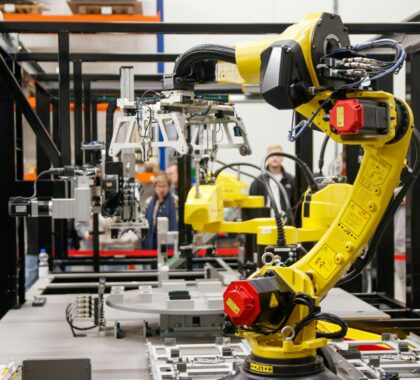
A single robot on a fixed base can only reach so far — but what happens when the work demands movement across an entire factory floor? The answer lies in industrial robotics automation extended through engineered robot tracks and 7th axis systems, transforming static cells into dynamic production lines.
Why Mobility Matters in Modern Manufacturing
Today’s smart factories require robots that don’t just repeat tasks in place — they need to traverse, adapt, and collaborate across variable workflows. Fixed robotic arms hit physical limits: reach constraints, blind spots, and inflexible layouts bottleneck throughput. Enter linear tracks and 7th axis systems: these solutions multiply a robot’s operational envelope without sacrificing precision or speed.
Engineering for Real-World Demands
Designing effective robot tracks and 7th axis systems demands more than off-the-shelf rails. Real-world environments introduce vibration, dust, thermal shifts, and uneven loads. Success hinges on:
- Load dynamics: Accounting for payload inertia during acceleration/deceleration
- Environmental sealing: Protecting guides and cables from debris and coolant exposure
- Integration: Syncing motion with the robot’s controller for coordinated path planning
Get this wrong, and you risk premature wear, positioning errors, or unplanned downtime — all eroding ROI.
Industry Impact: Flexibility at Scale
In 2026, industrial robotics automation is no longer about isolated cells — it’s about interconnected, reconfigurable lines. Companies deploying track-mounted robots report 30–50% faster changeovers and 20% higher asset utilization. This shift enables mass customization, just-in-line production, and rapid retooling for new product variants. [INTERNAL_LINK: smart factory integration].
How Alpha Edge Clients Stay Ahead
At Alpha Edge Technology, we engineer 7th axis systems around your workflow — not just the hardware. Our approach includes:
- Custom rail lengths and mounting for your floor layout
- Integrated safety zones and collision avoidance
- Digital twin validation before metal is cut
[INTERNAL_LINK: robotic cell design]
Takeaway: Build Smarter, Not Just Bigger
The future belongs to mobile, adaptive automation. Companies that master industrial robotics automation with tracks and 7th axis systems today will lead tomorrow’s agile factories. Start with simulation, validate with data Edge, then scale with confidence.